A Green Patch Is Not Always a Meadow
A green patch is not always a meadow: learn to read grasses, boundaries and seasonal signs before deciding how a field is used or managed.
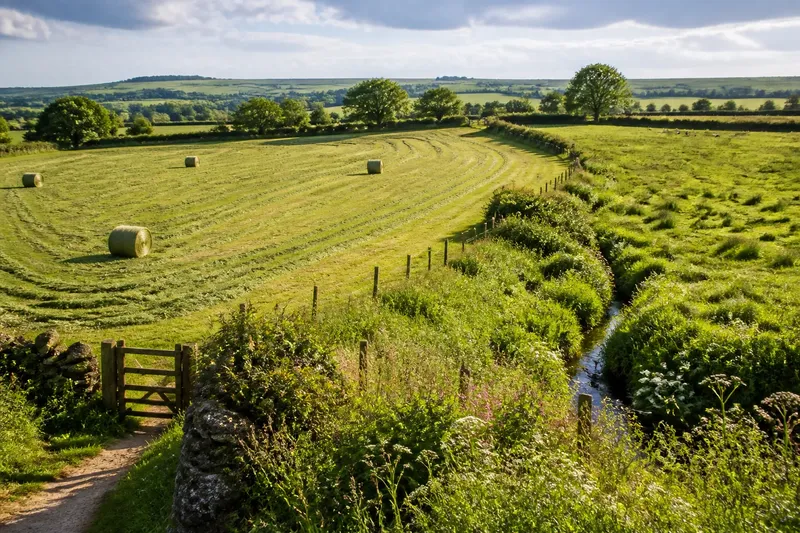
The common mistake is to call any open, green field a meadow. That quick label can hide what the grass is for, how it is managed and what the land looks like beyond a single season; it can also lead a walker to mistake a working pasture or recently cut field for a flower-rich grassland.
A green patch is not always a meadow, because colour and openness describe a view, not a land-use history. A careful reading begins with what is growing, what has been cut or grazed, and what changes through the year. None of those clues alone settles the question, but together they make a better account than appearance can.
What does “meadow” mean in the landscape?
In everyday speech, meadow often means open grassland. In rural use, the word commonly points to grass that is grown for hay and cut at a suitable point in the season, though local usage and management vary. Pasture, by contrast, is generally grassland used for grazing animals. These are useful distinctions, not labels that can always be read from a gate.
A field may shift between uses. Grass can be cut for hay in one part of the season and grazed afterwards; a pasture may be left to flower for a period; an old meadow can be reseeded or managed differently. The visible scene records a moment in that process, not necessarily the land’s usual role.
“Meadow” can also describe a type of grassland valued for its varied plants, rather than simply a field that produces hay. That distinction matters: a neat, uniform sward may be used to make hay without having the diverse flora many people associate with a meadow. Conversely, a patch of rough, flowering grass may have no hay-making role at all.
Use the word as a first impression, then qualify it: “hayfield”, “grazed pasture” or “flower-rich grassland” may be more informative when the evidence supports it.
Which visible clues tell you how grassland is used?
Look for a combination of signs rather than a single decisive mark. A recently cut field may show an even surface, rows of cut grass or bales awaiting collection. Those signs suggest mowing, but not its purpose: a cut may be made for fodder, to tidy vegetation, or as part of another management routine.
Grazing leaves a different pattern. The sward may be cropped unevenly, with taller growth around plants animals avoid, along field margins or near wet ground. Hoof marks and dung can support the reading, though they may be absent after rain, a recent cut or a period without livestock. A fence or water trough indicates possible use, not proof that animals are currently present.
Plant variety gives another clue. A field with several grass forms and broad-leaved plants, flowering at different heights, is visibly different from one dominated by a close, consistent carpet. But a brief flowering display does not establish how the field is managed, and a rich sward can be difficult to judge from a path or in poor light.
- Surface pattern: note whether grass is uniformly short, unevenly grazed or recently cut.
- Cutting traces: look for swaths, stubble or bales, then consider whether these are fresh or remnants.
- Plant mix: notice whether flowers and grasses vary across the field or gather only at its edges.
- Livestock signs: look for animals, dung, hoof marks and accessible water, without treating any one sign as conclusive.
- Field edges: compare the centre with banks, ditches and margins, where taller plants may persist under different conditions.
Stand back before naming the field. A change in height or colour across it may reflect different soil, drainage, shade or management zones rather than a single uniform use.
Why can a field look different from one season to another?
Grassland is read in time as well as space. Spring growth can appear lush and uninterrupted before flowers develop; later, flowering stems make variation easier to see. After cutting, the same field may look plain and close-cropped. A winter view can conceal much of the plant diversity that shaped the summer scene.
Weather affects the timing and appearance of work. Wet ground may delay machinery or grazing, while dry conditions can leave cut vegetation and soil looking pale. A visitor who sees a field just after mowing may assume it is permanently uniform, though the earlier growth and later regrowth may tell a different story.
Even a familiar field can change its role. A farmer may adjust grazing, sow new grass, leave a strip uncut or alter the time of mowing. Some changes are visible for a short period; others gradually alter the plants that return. Without local knowledge, a walker can describe what is present but should be cautious about explaining why it is there.
When returning, note the month and the field’s condition. A short record of “cut”, “flowering”, “grazed” or “standing through winter” is more reliable than a permanent label based on one visit.
How can you describe a green patch without guessing?
Separate observation from interpretation. “Short grass with cut stems and a few bales” reports what is visible. “A hay meadow” adds a claim about use and perhaps about the grassland’s character. The second may be right, but it needs more support than a glance can provide.
Imagine you pass a green field in early summer. The centre is cropped short, while a taller strip beside a ditch carries flowers; a gate opens onto the field, but no animals are visible. You could record “short grass, flowering ditch margin, no livestock seen” and revisit later. That wording preserves the evidence without deciding whether the field is pasture, a cut field or a mixed-use grassland.
When asking someone who knows the land, be precise about the question. “Is this cut for hay?” is easier to answer than “Is this a meadow?” The latter may refer to the field’s use, its plant community or a local name, each of which can have a different answer.
Keep to public paths and avoid entering fields to inspect plants or machinery. A view from a bridleway, roadside verge or public footpath can still reveal the broad pattern, while respecting livestock, crops and working access.
What questions help distinguish meadow from pasture?
Does a flower-filled field have to be a meadow?
No. Flowering plants can occur in pasture, a field margin, a temporarily ungrazed area or land managed for other reasons. The flowers describe what is growing at that moment, not the field’s purpose.
Does a hay cut prove that a field is a traditional meadow?
It shows that the grass has been cut, and the cut may be for hay, but it does not establish a long-term management history or a diverse plant community. Look for repeated seasonal observations or ask a local land manager if the distinction matters.
Can pasture look like a meadow?
Yes. Livestock may be absent when you pass, or grazing may be light enough for flowering plants to remain. Check the sward for grazing patterns and treat fences or troughs as supporting clues rather than a complete account.
What is the safest name when the use is unclear?
“Grassland” or “green field” is accurate when the evidence does not settle the use. You can then add the details you can see, such as “recently cut” or “unevenly grazed”, without turning a guess into a fact.
When should you leave the label open?
Leave room for uncertainty when clues conflict: a cut centre with a flowering edge, for example, may reflect different management within one field. Do the same when the scene is obscured by distance, seasonal growth or a boundary that blocks the view. The aim is not to avoid useful distinctions, but to make only those the landscape supports.
For a field note, a plain description can be more useful than a confident category: “open grassland, recently cut, with taller growth near the ditch”. It gives another walker something observable to look for and remains accurate if local use turns out to be different.
When you next see a green patch, ask what the grass is doing now and what evidence might reveal its use over time. A measured description of a green patch is often more informative than calling every open field a meadow.