Why Valley Floors Often Hold the Mist
Why valley floors often hold the mist: read the slope, wind and stream to judge where a morning veil may linger and where a clearer walk may lie.
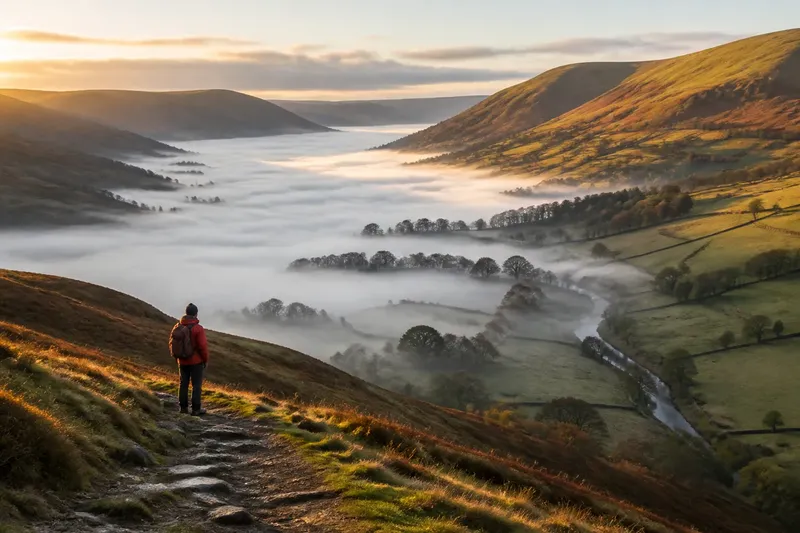
The common mistake on a misty morning is to assume that the whole countryside is equally obscured. Why valley floors often hold the mist becomes clear once you notice how cold air gathers in low ground, while a nearby shoulder or ridge may already sit in sunlight. For a walker, the shape of the valley helps explain not only where the veil lies, but how it may change along the way.
What does the valley shape tell you?
After the ground loses warmth overnight, the air close to it cools too. Cooler air is denser than warmer air, so it can drain down slopes and collect in hollows, much as water follows a shallow channel. If the air contains enough moisture, tiny suspended droplets make that pooled layer visible as mist.
A broad, open valley gives the air room to spread. Its floor may be veiled unevenly, with clear patches beside thicker wisps; a narrower valley can confine the cool air and reduce the routes by which it disperses. Neither shape dictates the outcome. Cloud cover, recent rain, the amount of moisture in the air and any passing breeze all influence what you see.
Look at the sides as well as the floor. A steep slope offers a short route downhill for cooling air, while a shallow slope may feed it more gradually. A bend, side hollow or narrowing can interrupt the flow and make mist appear in one reach but not the next.
Which situation sounds like your walk?
Choose your route according to the landscape you want to read, rather than expecting one forecast or viewpoint to describe every part of the valley. These situations can overlap; a stream-side hollow may also be enclosed, for instance.
- You want to see where mist is most likely to collect. Try a low, enclosed valley floor, especially where slopes descend towards a stream. It is a natural place to look for a cool-air pool, though the mist may be patchy or absent if wind has mixed the air.
- You want a better chance of a clear view. Choose a route that climbs to an open shoulder or ridge. Higher ground may lie above the low layer, giving a view over the mist rather than through it; exposed slopes can also feel breezier and colder.
- You want to watch the boundary between clear and veiled air. Walk a gradual slope or a path that leaves the floor for higher ground. The transition may be more revealing than a viewpoint, as the depth and edges of the mist become visible around you.
- You want a sheltered, quiet walk. A wooded or enclosed lower route may suit you if reduced visibility does not trouble you. Nearby slopes can block wind, but trees and bends may also hide the path ahead and make the mist feel denser.
- You are choosing between a stream valley and a dry hollow. Either can collect cooled air. A stream supplies a nearby source of moisture, but valley shape and the wider weather still matter; a dry hollow can hold mist too.
Say you reach a broad valley mouth and see a grey band lying beyond the first bend. If you want to watch its edge, follow a familiar path that rises gently from the floor; you may then see the band’s upper surface and where it thins, rather than walking straight into the thickest part.
How do wind, water and slope change the view?
Wind is often the strongest clue to whether a cool-air pool will remain distinct. A light breeze may stir the mist into shifting ribbons, while stronger air movement can mix the lower layer with warmer air above and disperse it. Sheltered hollows can retain a quieter pocket when nearby open slopes feel breezier.
Waterways add detail, not a simple rule. A stream or wet ground can contribute moisture close to the floor, and the banks may sit in a narrow hollow where cool air gathers. But mist over a stream is not proof that the whole valley is fogbound; the veil may follow the water for only a short distance.
Valley orientation affects how sunlight reaches the ground. A shaded floor may warm later than a slope exposed to morning sun, so the mist can linger there after nearby ground begins to clear. The result depends on the direction of the valley, its bends, surrounding hills and the cloud above it.
Keep an eye on the visible horizon as you walk. If landmarks on the valley sides remain sharp while the floor is hidden, the mist is likely concentrated low; if the opposite slope fades too, the obscured layer may be deeper or more widespread.
What should you check before setting out?
A valley’s shape helps you interpret conditions, but it is not a substitute for deciding whether the route suits the visibility. Check the practical details that affect your own walk:
- Route familiarity: if the path has junctions, exposed edges or awkward crossings, choose a clearer day or a route you know well.
- Visibility along the route: look beyond the view from your starting point; a clear ridge can lead down into a much thicker pocket.
- Wind and cloud: a breeze may shift the mist, and cloud can keep the valley floor shaded. Treat both as changing conditions, not a promise of what the route will look like.
- Ground underfoot: damp grass, mud and concealed surface changes can make a familiar path less straightforward.
- Return options: note a simple way back or a higher alternative before entering an enclosed hollow.
- Local access: follow signs and keep to permitted paths, especially where the route passes working land or water.
If sightlines become too short for you to follow the path comfortably, turn back or use a clearer route. There is little to gain by pressing on simply because the mist looks striking.
Why does mist linger in one reach of a valley?
Does a narrow valley always have thicker mist?
No. A narrow valley can shelter a cool layer, but wind, sunlight and moisture can change the result. A broader hollow may hold a more extensive pool, while a narrow reach remains clear if air moves through it.
Will a stream make the valley mistier?
A stream can add moisture and mark a low channel, so mist may be noticeable nearby. It does not determine the whole pattern: the slope, wind and overnight cooling also shape where droplets remain suspended.
Why can a hillside clear before the floor?
A hillside may receive direct sunlight sooner or sit above the coolest air gathered below. As the slope warms and the air mixes, a walker can see the floor remain veiled while higher ground is clear.
Can mist appear in a hollow without a stream?
Yes. A hollow can collect cool air even when no watercourse crosses it, and moisture already present in the air may be enough for mist to form. A stream is one influence, not a requirement.
How can you read the changing edge?
Instead of treating mist as a fixed blanket, watch how it meets the contours. A tongue of grey air may extend up a side valley, while a sunlit shoulder remains clear; a bend can hide the next section of floor without changing conditions on the ridge.
Pause at a safe, open viewpoint and compare several features: the nearest slope, the far bank, any stream line and the lower end of the valley. If the mist is lifting, edges may grow softer and separate patches may break apart. If it thickens or shifts across the path, adjust your route rather than relying on the appearance from a distance.
Why valley floors often hold the mist is ultimately a question of contours meeting overnight cooling, moisture and air movement. For a walker, the useful distinction is between a low route that enters the pooled layer, a slope that crosses its edge and a ridge that may look over it. Read the ground as you go, and let the route you choose match both the view you want and the visibility you have.