Hedge, Wall or Fence: Reading a Field Edge
Learn to read a field edge from its plants, stones and posts, and describe the boundary clearly without guessing how or when it began.
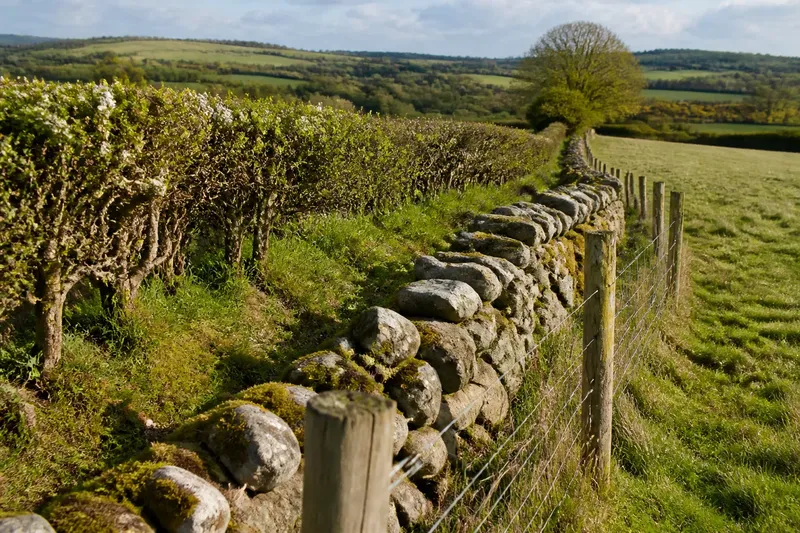
The common mistake when reading a field edge is to call every rough, green boundary an ancient hedge, or every line of stones a dry-stone wall. That shortcut can turn a useful observation into an unsupported story: what you can see is the boundary’s present form, not necessarily its age, ownership or original purpose.
A hedge, wall or fence each offers different clues. Describe the material, shape and continuity first; treat any explanation of how the boundary came to be as a possibility, not a fact.
1. What does a hedge reveal?
A hedge is a line of woody plants, usually grown close enough to form a dense or partly open screen. Look for stems emerging from the ground, branches woven together, and changes in height or thickness along the line. Hawthorn, blackthorn, hazel and field maple may occur in hedges, but no single species identifies every boundary.
Notice whether the plants form a continuous bank, sit on a raised earth ridge, or grow in a ditch-side strip. A ditch beside a hedge may help explain the boundary’s layout, but it does not, by itself, establish who made it or when. Gaps, cut ends and younger growth can also show where the line has been altered or maintained.
For a clear description, say “a dense hawthorn hedge with a shallow ditch on the field side” if those are the features you can actually see. Avoid turning a visual description into a claim that the hedge is an original parish or property boundary.
2. How can you recognise a wall?
A wall is built from stone or another masonry material, and its construction is often more legible than a planted boundary. In a dry-stone wall, stones are fitted together without visible mortar. Check for a broad base, a narrower top, large stones along the outer faces and smaller packing stones between them.
Some walls have upright coping stones along the crest; others finish with flat or irregular stones. A wall may be partly hidden by grass, moss or shrubs, so look for repeated stone faces and a consistent built line rather than relying on a single exposed patch. Mortar, if present, is a visible detail to record, not a reason to assume the wall belongs to a particular period.
Walls can also be repaired in sections, with newer stone differing in colour or arrangement from older-looking stretches. Write down that contrast without assigning a date. A wall’s material and workmanship are evidence; its story may remain uncertain.
3. What does a fence tell you?
A fence is identified by its assembled parts: posts, rails, wire, netting or boards. The supports may be timber or metal, and the infill may be taut, sagging, rusted or partly obscured by plants. Note what is present and how the components meet, rather than treating “fence” as a single standard design.
Posts set at regular intervals can make a boundary look sharply defined, while wire or mesh may disappear against grass and scrub. A fence can run through a hedge or stand beside a wall, so the visible edge may combine several forms. Describe each element separately: “wire fencing follows the hedge, with timber posts at the opening” is more informative than “a fenced hedge”.
Broken sections, leaning posts or a gate can help you describe the boundary’s current condition and access points. They do not establish whether the fence is temporary, neglected or intended for a particular use.
4. How should you describe a mixed or unclear edge?
Field edges are not always neatly divided into one category. A low stone wall may carry a hedge; a fence may reinforce a bank; or scattered trees may follow the line of an older boundary. Name the parts you can distinguish, then say where one gives way to another.
Imagine you see a raised grassy bank with thorny shrubs and a wire line fixed to short posts. A careful note might read: “A raised bank supports a discontinuous thorn hedge, with wire fencing along its outer side.” That records the starting point—the visible bank, plants and wire—and gives a reader a result they could look for themselves, without inventing a date or origin.
If vegetation hides the construction, say that the material is unclear. “A thick boundary of scrub, with occasional stone visible at ground level” is a useful description; calling it a wall would go beyond the evidence.
5. Which clues are easy to misread?
A straight line can look deliberate, but straightness alone does not tell you whether it was planted, built or fenced. Nor does a winding edge prove that it follows an old track or natural feature. Treat alignment as a characteristic to note, not a conclusion.
Plants growing on a boundary can obscure a wall or fence, while fallen stones may make a built edge look like a loose pile. Conversely, a bank can contain stones without being a wall. Look for repeated construction features before choosing a label, and keep uncertainty in your wording where those features are hidden.
Where the question depends on a boundary’s legal status, ownership or permitted alteration, visual clues are not enough; consult the relevant land records or a qualified professional.
What should I look for first?
How do I tell a hedge from scrub?
A hedge usually follows a recognisable boundary line and has woody growth arranged as a continuous or intentionally maintained strip. Scrub may be more irregular, but overlap is common, so describe the visible growth and its alignment rather than claiming how it was managed.
Can plants identify a hedge’s age?
Plants can help describe its composition, but a species list alone does not establish age. Record the species you can identify with confidence, along with features such as a bank, ditch or gaps, and leave chronology open.
Is a stone boundary always a wall?
No. It may be a built wall, a collapsed section or loose stone gathered along an edge. Look for a continuing face, courses or a consistent profile; if these are absent, “stones along the field edge” may be the more accurate description.
What if a fence is hidden by plants?
Look for exposed posts, wire, mesh or rails at gaps and openings, without pulling vegetation aside. If no construction is visible, describe the boundary as a planted or scrub-covered line and note that a fence may be concealed rather than asserting that one is there.
When reading a field edge, begin with what your eye can verify: living stems, shaped stone, posts, wire, a bank or a ditch. That simple discipline makes descriptions more precise and leaves room for the landscape’s history to be investigated rather than guessed.