The Millpond and Its Working Water
A millpond stored water for a mill, linking a pond, controlled channel and wheel; learn how their relationship shaped the flow that powered the work.
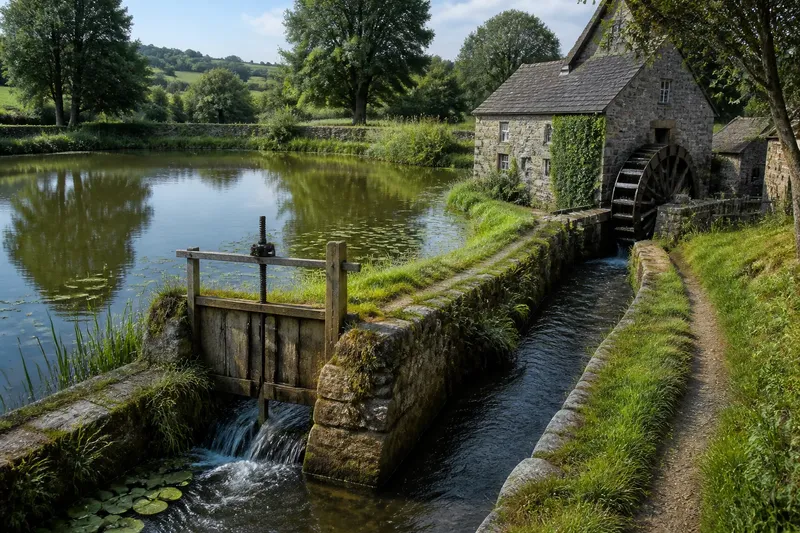
The common mistake is to think of a millpond as a broad pool beside an old mill. Its water was not merely scenery: it was stored energy, held back and released through a route that brought it to the machinery. Understanding that relationship between pond, channel and mill makes the landscape around a former mill easier to read.
Why hold water beside a mill?
A stream does not always deliver a steady flow. Rain can swell it, while dry spells may leave it too weak to turn a wheel reliably. A pond gathered water behind a barrier, allowing the mill’s operator to draw on a reserve rather than depend only on the stream’s immediate condition.
The pond also made the water level easier to manage. By controlling when water left the storage area, an operator could direct a useful flow towards the wheel and, at other times, allow the pond to refill. This was not an endless supply: the reserve was limited by rainfall, inflow, leakage and the water already committed downstream.
Look for the broad, relatively quiet water and the raised bank or dam that holds it. Their position in relation to the stream often reveals that the pond was part of a working arrangement, not simply a natural widening of the watercourse.
How did pond, channel and mill connect?
Water generally passed from the pond towards the mill along a controlled route. Depending on the site, this might be a millrace or leat: a channel that carried water from the stored supply to the wheel. A sluice or similar gate could regulate the flow at an entrance or along the route.
At the mill, water acted on a wheel, turning an axle that transferred motion to the machinery inside. The precise wheel and machinery varied, but the basic sequence was the same: stored water entered the channel, reached the wheel, and then continued away through a tailrace or returned to a stream.
Imagine a small mill beside a stream whose flow slackens after dry weather. Its pond collects water while the mill is not drawing heavily; when work is needed, the operator opens a sluice to send water down the leat. The expected observable result is a stronger, directed flow at the wheel, followed by a reduced pond level until inflow restores some of the reserve.
- Pond: the storage area that holds water back.
- Dam or bank: the raised structure that helps retain it.
- Sluice: a gate or control point that regulates release.
- Millrace or leat: the channel carrying water towards the mill.
- Wheel and tailrace: the machinery receiving the flow and the route by which it leaves.
What can the channels tell you?
The stream and the millrace need not follow the same line. A channel may leave the main watercourse upstream, skirt a bend, and reach the mill where a suitable drop or approach can be made. The stream itself then continues along its own course, sometimes passing close to the building before the flows meet again.
That arrangement can make the mill seem detached from the water that powered it. A shallow, straight cut through grass, a low bank running parallel to a stream, or a channel that approaches a building from one side may mark the route of a leat. The tailrace may be less conspicuous because it rejoins the stream quickly or has become overgrown.
Do not assume every ditch beside a pond is a mill channel. Field drainage, later diversions and natural side channels can look similar. Trace the line cautiously with your eyes: does it lead from a controlled outlet towards the mill, and is there a plausible route away from the wheel?
What happens when the flow changes?
A millpond works through a balance between water arriving and water being released. If the mill draws water faster than the stream replenishes the pond, the stored level falls. If inflow exceeds the amount released, water rises and may need to pass over a spillway or another overflow route.
These changes explain why a pond’s edge may look uneven or why a low, stone-lined channel lies beside a bank. Such features can guide excess water away from vulnerable ground or reduce pressure on the retaining structure. The exact arrangement differs from one mill to another, so read each feature in its setting rather than treating it as a standard design.
Water also had to be shared with the stream below. A diversion could alter the flow between the point where water left the stream and the place where it returned. The mill’s working supply was therefore part of a wider watercourse, not a sealed pond and private channel.
How can you read a millpond landscape?
Start with relationships, not isolated objects. Notice where the stream enters or passes the pond, where a bank holds water, and whether a narrow channel seems to leave the pond towards a mill building. Then look for a likely return route downstream.
From a public path, these observations can help distinguish storage from flow. A broad expanse of still water suggests the reserve; a narrower, more regular channel suggests a directed route. A change in ground level between the pond and mill may help explain how water could reach a wheel, though vegetation and later alterations can obscure the original arrangement.
For safety, keep to public access and do not approach unstable banks, sluices or fast-moving water. Where structures are maintained or altered, their operation depends on local conditions and the responsible operator’s instructions.
What do readers often ask about millpond water?
Was the millpond the same as the millrace?
No. The pond stored water, while the millrace or leat carried a controlled flow towards the mill. They were connected parts of the system, but served different purposes.
Did all mills use a pond?
No. Some mills relied more directly on a stream or used other arrangements suited to the local flow and ground. A pond mattered where holding water helped make the supply more manageable.
Where did the water go after turning the wheel?
It usually left by a tailrace or another channel and returned to a stream or watercourse. Following that downstream route can help make sense of the mill’s position.
Why might a millpond remain after the mill stops working?
The pond and its banks can persist after machinery falls silent because they are substantial landscape features. Water may still be retained or managed for other local purposes, so the present arrangement need not match the former working flow.
What makes the water “working”?
The useful feature of a millpond was not simply its volume, but the way it connected storage to controlled movement. The pond held water; the sluice governed its release; the channel delivered it; and the mill converted its motion into work before the water returned to the stream.
That sequence is the clearest way to interpret a millpond in the countryside. When you follow the line from pond to channel to mill and back towards the watercourse, the quiet surface becomes legible as part of a working system.