A Late-Autumn Walk Along the Woodland Edge
A late-autumn woodland edge walk helps you read shifting light, fallen leaves and the tree line, with a calm method for noticing seasonal change.
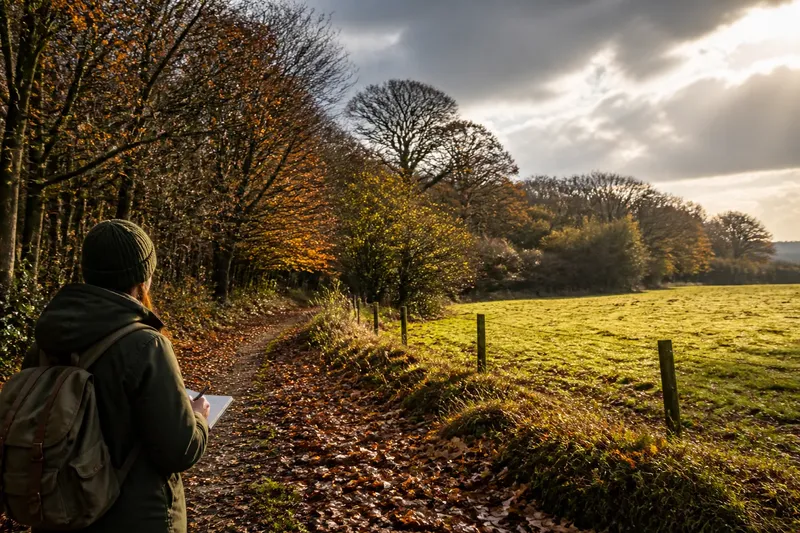
The common mistake on a late-autumn woodland edge walk is to look only into the trees. That leaves the open ground, the fallen leaves and the changing outline out of view—the very details that show how woodland meets field. Take the edge as a line to follow with your eyes, not merely a boundary to pass.
Imagine you arrive at a public footpath where a stand of ash, oak and hazel borders a rough pasture. The sky is bright but cloud is moving in from the west; leaves lie in a shallow drift against the path. You have no special equipment, only a pocket notebook and enough time to walk slowly. The aim is to notice how light and ground alter the appearance of the trees, then leave with a clearer sense of what the edge is doing.
Where should the walk begin?
Choose a place where you can see both the tree line and a stretch of open ground without leaving the path. A bend, a gate on a public route or a gap between trunks may offer a useful view. Avoid stepping into crops, pasture or planted woodland to improve the angle; the edge can be read from the route itself.
Pause before walking on. Notice the direction of the light, whether the sky is evenly bright or divided by cloud, and which parts of the tree line are easy to distinguish. These are not measurements to record as facts. They are a starting impression you can compare with what you see later.
At the invented walk’s starting point, the pasture appears pale beneath a thin cloud and the woodland reads as a dark, almost continuous band. The first useful observation is not the identity of each tree, but the contrast between those two surfaces.
What does the changing light reveal?
Late-autumn light often moves across the landscape in patches as clouds pass. A sunlit section of grass may brighten while the trees behind it remain shaded; moments later, the contrast can soften. Watch the same stretch of edge through these changes rather than treating one view as definitive.
Notice where the light catches the remaining leaves. A few copper or yellow crowns may stand out above the darker branches, while lower limbs have already become bare. The difference is especially clear when you look across the tree line instead of directly into the woodland, because the outer branches make a profile against the sky.
In the imagined walk, the cloud thins and a strip of low sunlight reaches the pasture. The trees appear less like a single dark wall: a hazel clump projects forward, while a taller oak sits behind it. When the light fades again, those layers merge. The change is in the view, not in the position of the trees.
Keep a note of what becomes visible only in certain light. A small opening, a leaning branch or a gap between crowns may disappear in shade and return when the sky brightens. Such brief details help explain why an edge can seem irregular from one stopping place and smooth from another.
How do fallen leaves describe the edge?
Leaves do not always land beneath the tree that shed them. Wind can carry them onto the path or field, and a ditch, bank or rough strip of grass may gather them into a shallow line. Look for changes in colour and texture, rather than assuming every drift marks a precise boundary.
At the footpath in the invented scene, oak leaves have collected against a grassy lip, while smaller leaves are scattered farther across the pasture. The lip interrupts their movement and gives the eye a short, broken curve. That curve is worth noticing, but it should not be read as proof of a property line or a formal woodland limit.
Compare the leaf cover with the ground around it. Bare patches may show where walkers pass, where grass remains exposed, or where the wind has swept leaves aside. Damp leaves can look darker and flatter than dry ones, making a drift seem denser than it did earlier in the walk.
Keep to the path and leave the leaves where they lie. A photograph from the same safe viewpoint can preserve a pattern for comparison in another season, while a few words in a notebook can capture what the image misses: the ground’s dampness, the direction of the wind, or the way a drift breaks around tufts of grass.
Why does the outline seem to change?
The woodland edge is not necessarily a straight line of trunks. Younger trees, shrubs and overhanging branches can make its outline bulge, dip or feather into the open ground. In late autumn, the loss of foliage makes some of these forms easier to separate, although dense evergreen growth may remain visually solid.
Look first at the upper outline against the sky. Then lower your gaze to the branches and shrubs nearest the path, where the edge may have more depth than the distant crown suggests. A bare branch extending over grass can make the woodland seem to reach farther out; a recessed group of trunks can make it appear to pull back.
In the imagined walk, the walker initially records a smooth tree line. After stopping at a second viewpoint along the path, the line resolves into a shallow projection of shrubs and an open notch behind it. The lesson is modest but useful: one viewpoint can flatten the edge, while a small change in position reveals its uneven shape.
What should you notice at each pause?
A few repeated questions help keep the walk attentive without turning it into a formal survey. At each safe stopping place, ask:
- Where is the brightest patch of ground, and what lies behind it?
- Which parts of the tree line still hold leaves, and which show bare branches?
- Where have fallen leaves gathered, and what feature might be holding or redirecting them?
- Does the edge look continuous, or can you pick out separate clumps and openings?
- What changes when you look from the upper crowns down to the grass and path?
For the hypothetical walker, the answers shift along the route. The sunlit pasture gives way to a shaded strip; the leaf drift thins beyond the grassy lip; the apparent wall of trees breaks into distinct groups. By the end, the notes describe a sequence of views rather than a single fixed picture.
How can you keep the walk observant and considerate?
Use an established public path and check any local access signs. Do not cross a hedge or fence, enter a field to inspect a leaf line, or disturb wildlife for a closer view. If the path is muddy, keep to its firmest part where possible rather than widening it at the edge.
Weather can change the character of the walk quickly. A gust may move loose leaves; a fresh shower can darken the ground and reduce visibility. If conditions make the route uncomfortable or unsafe, turn back rather than trying to preserve the planned view.
A phone camera can help you remember the outline, but take the image from the path and include a recognisable feature such as a gatepost or bend. A notebook is better for comparing impressions: write down what the light was doing and which detail caught your attention, without trying to make the description sound definitive.
What questions arise on a late-autumn woodland edge walk?
Is late autumn a good time to notice the shape of trees?
Yes, the thinning canopy can make branches, gaps and projecting shrubs easier to distinguish. Evergreen trees and dense undergrowth may still hide parts of the outline, so treat the view as partial.
Do fallen leaves show where the woodland ends?
They can suggest how wind and ground features move or hold leaves, but they do not define a legal or permanent boundary. Read a drift alongside the path, bank and vegetation, rather than taking it as a line on its own.
What is useful to record during the walk?
Note the route position, the light, the visible shape of the edge and any distinct leaf drifts. A short description can be more useful than a collection of photographs if it explains how the view changed between pauses.
Can I compare the same edge in another season?
Yes, returning from the same public viewpoint can make seasonal contrasts easier to notice. Keep the comparison modest: light, weather and growth vary, so the later view will not be an exact repeat.
What does the walk leave you with?
At the end of the invented walk, the woodland still looks much as it did at the start, but the walker can describe its visible structure more carefully: a darker stand behind the pasture, an uneven fringe of shrubs, and leaves held briefly by a grassy rise. The result is not a claim about how the woodland formed, but a more attentive account of what the eye can see.
A late-autumn woodland edge walk is most rewarding when one view is allowed to change before you move on. Next time you pass a familiar tree line, pause long enough to see whether light, leaf drift or a bare branch has altered its shape—and let that small observation guide where you look next.